Dear Startup Investor:
Most of us take clean water for granted.
But in large swaths of the developing world, clean water is only a dream. I know. I’ve been to many places in Asia, Africa and Russia where the water was filthy. I’ve also marketed clean-water technology in these regions.
These technologies all carried the “made in the USA” label. I learned early on in my three decades of doing business globally that America has some of the best technology for water purification in the world.
And now that I have examined the technology of startup company Liquidity Nanotech, I believe that more than ever.
Its filter technology is remarkable on many levels: simplicity of use, safety, low manufacturing cost and the EPA-quality water it produces.
Amazingly, it also removes the need for power, pressure and chemicals.
Liquidity’s technology alone gives it a huge advantage in the water-purification market.
So let’s begin by taking a closer look at its technology.
High-Tech Membrane That No One Else Makes
Liquidity’s technology relies on a remarkable, first-of-its-kind membrane that removes contaminants physically. Think of a wire-mesh colander you’d use for pasta. Its holes let the water drain, leaving the pasta (or solids) behind.
Well, Liquidity’s membrane is made up of microscopic holes. In fact, the holes constitute 85% of the membrane. This breakthrough technology produces the only porous membrane (technically called “size-exclusion” membrane) that just uses gravity to rid water of its microbiological impurities at a meaningful level.
You can thank two professors, who spent thousands of hours perfecting the membrane at an obscure lab tucked away in a quiet corner of the Stoneybrook University campus, for this technology.
Customers confirm that the membrane effectively removes bacteria, viruses and protozoa. (Many protozoan species are symbionts, some are parasites and some are predators of faecal bacteria and algae. There are an estimated 30,000 protozoan species.)
Customers also say the membrane filter works three times better than competitive chemical-based products.
And it’s much safer to use. Pour any non-salt water through the cartridge and drink it safely.
It’s that simple.
No one else has it. And no one else can make it at scale.
Liquidity also designed and built its machines from scratch, so its manufacturing process is as unique as the membrane itself.
I asked the company if its patented technology could be reverse engineered. They said no.
That would have been the only way to jump over the deep moat Liquidity has dug for itself.
Moats are important. Liquidity has great technology and it believes (as I do) that it has found an ideal market fit with the vast emerging global middle classes. But a competitor with the same or better technology is always capable of upsetting the apple cart.
Liquidity doesn’t have to worry about that. Not for the foreseeable future, at least.
That’s a big risk off the table.
Traction
Liquidity is still in its pre-revenue phase. That changes next spring.
Its first launch is planned for the U.S. And why not? As I’m sure you know, this country has a fast-growing health and wellness sector. Liquidity is joining forces with fellow exciting startup GOBIE h2o. GOBIE makes water bottles that come with their own built-in filtration systems. In 2015, GOBIE will offer water bottles that use Liquidity’s special membrane filters.
Shortly thereafter, Liquidity will initiate a second marketing campaign in India’s fast-growing $1 billion market. Water quality is a huge problem there. India already has millions of installed water purification devices in homes and offices, but tens of millions of other places can only access unhealthy tap water. A measly less than 10% of homes use some sort of water purification system.
Liquidity plans to both retrofit the filtration systems already in place and sell new systems to those who don’t have one yet. By the way, Liquidity’s cartridges are custom-designed to work with any dimensions, any connection and any water purifier format.
Liquidity has also lined up customers in several east African markets and South America. They all have 2015 launches scheduled.
By the end of next year, Liquidity plans to hit the $1 million mark in revenue. But the real jump in revenue generation won’t come until 2016.
That’s when revenue is expected to surge to well over $20 million, as this chart from Liquidity shows…
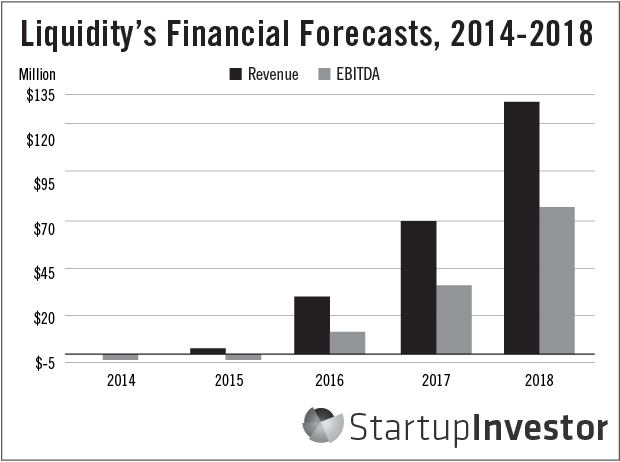
These are projections based on expressions of interest from the company’s growing customer pipeline. There’s nothing wrong with that. But they are not orders, or even pre-orders. And they do not represent a contractual commitment.
There is always a drop-off in such projections when a company is ready to accept real orders. Plus, marketing to large developing countries is rarely smooth. The timelines often get stretched.
That said, the company’s marketing plan is sound and doable. But it’s also subject to possible delays and a modest drop-off in customer requests.
The Startup Investor team believes these concerns are manageable, more than offset by the company’s substantial upside beginning in 2016.
Other compensating considerations include…
- A large and growing $9 billion global market that is expected to total about $15 billion by 2018
- A low-risk, “printer cartridge” marketing model that encourages continued and repeatable sales and relies on global OEMs to make and market the finished product
- Low cost and high profit margins
- Market range and versatility, from moms in Manhattan to the poor in Bangladesh
And I haven’t even mentioned Liquidity’s strong team yet.
The Team
Liquidity has six co-founders, an unusually large team. But each co-founder brings an exceptional and unique skill set to the company.
The one exception is Stonybrook’s two professors of chemistry, Ben Chu and Ben Hsiao. That’s okay. As inventors of this unique technology, both deserve a place on Liquidity’s team.
And they get plenty of business help from Dean Spatz. He’s the founder and former CEO of Osmonics. Osmonics was sold to GE for $248 million in 2003. Spatz brings over 40 years of experience in water purification technologies to the co-founding team.
Fellow business heavyweight Mark Kachur is another member of the founding team. He has spent the last four decades leading filtration and purification technology companies. He was CEO of CUNO when 3M bought it for a cool $1.35 billion in 2005. CUNO was a tech leader in microfiltration and residential water filtration at the time.
Mike Hawes is Liquidity’s CEO. He was vice president of Worldwide Water Group at 3M-CUNO. Hawes grew global sales there to $220 million. He has over 20 years of filtration technology and water purification experience.
The CFO position belongs to Victor Hwang, who also is manager of T2 Venture Capital. T2 focuses on breakthrough technology from government and academia. As a senior executive at Veatros, a video search company, he led the company’s acquisition by DivX. Hwang has also structured dozens of venture capital and technology transactions as a corporate attorney.
The Opportunity
Liquidity did its Series A round in 2011, raising $7.4 million. It’s now raising $2.5 million more in a “Series A extension” round. Pre-money valuation is around $15.34 million.
You’d be investing alongside Kevin Fong, a prominent Silicon Valley investor. Fong is a special advisor to GSR Ventures, which he helped start in 2004 to focus on investments in China. He’s made more than $1 billion in returns to limited partners in the past 23 years from investments such as Citrix, Crescendo (now Cisco Catalyst), and Redback Networks (acquired by Ericsson). His recent exits include 3Par, which was acquired by HP for $2.35 billion.
Capricorn Investment Group is another major investor in this round. Capricorn was founded by Jeffrey S. Skoll, eBay’s founding president.
The startup portal, Onevest, is sponsoring the company’s online general solicitation fundraiser. As an investor in this bridge round, you can invest as little as $10,000. Your money will go into a special purpose vehicle (SPV), along with Onevest’s other investors.
The SPV will purchase “Liquidity Series-A preferred membership interests.” So let me explain exactly how this works.
Investors do not get shares of Liquidity, as such. That’s okay. Anybody who has invested in mutual funds is familiar with this kind of set-up. But here’s a hypothetical that spells it out.
So, let’s say, instead of buying 50 out of 50,000 shares, you’re buying a 0.1% of the company that holds the 50,000 shares. Your interest in the company is the same as the value of the 50 shares. So, if those 50 shares go from $10,000 to $100,000, your 0.1% interest would do the same thing and be worth the same amount, $100,000.
Startups do this so they don’t crowd their cap table with dozens, if not hundreds, of shareholders. It’s an unwieldy number of shareholders to manage. Plus, VCs don’t like it. And they’re the ones Liquidity will be raising money from in the later rounds.
I should also note that you will have the right to invest in the later rounds to maintain your 0.1% interest (continuing our hypothetical above).
For first-time visitors to Onevest, you’ll need to go to the Onevest site and register right here. Next you’ll go to Liquidity’s page, here and look for the orange box on your right, which says “I’m interested In Investing.” Click on it. Onevest will bring you through a series of forms and questionnaires you will need to complete in order to be approved to invest. It sounds like a lot of work, but it shouldn’t take you more than a few minutes to go through from start to finish. Everything is done via e-signatures on the site. It’ll take a day or two for Onevest to get back to you with an approval on your investor application.
At that point, further instructions will be provided by Onevest on how to invest in Liquidity’s SPV.
Sincerely,

Andrew Gordon
Startup Investor Portfolio