Dear Startup Investor:
This recommendation is a little different. For one, how would you like to start cashing in on this investment I’m recommending to you as soon as one year from now?
You can, because it targets mature or late-stage startups poised to potentially go public in the next one to two years.
Mature startup sounds a bit like an oxymoron, so let me fill you in.
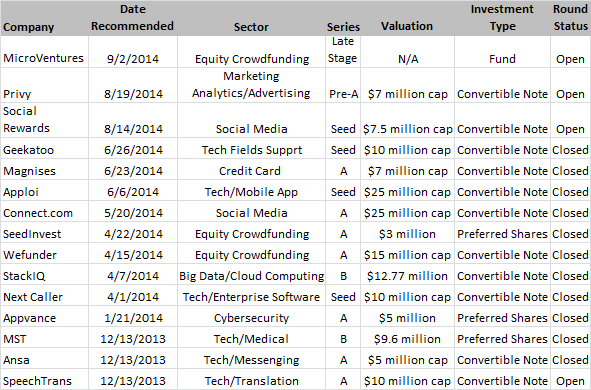
To date, I’ve recommended startups fresh out of the gate. Some were raising seed funds. Others had moved on to the next round, known as Series A. We have just one Series B startup in our portfolio.
The great thing about investing this early is that you usually can get a great price. After all, you’re investing in fledgling companies before they reach the growth stage.
The one bad thing?
You have to be patient as the startup develops into a self-sustaining and profitable company. That can take five to seven years on average.
I love the exceptions, the companies that get bought out or IPO in one to three years. It happens every now and then and I suspect our Startup Investor portfolio will have a couple at some point.
But they’re next to impossible to predict. And you should never count on it happening.
And when it does happen, you should thank your lucky stars.
So I can’t be more pleased to report to you that the recommendation I’m making to you today will have companies with an average two-year runway to a “liquidity event,” meaning an IPO or an acquisition (if it’s an IPO, you’ll have to wait 180 days to cash out).
Yes, the shares are a little more expensive. But since these companies are very close to going public, the desired outcome we hope for in all our startup investments – an IPO, preferably – is much more predictable.
So much so that even the timing of the IPO can often be projected with reasonable accuracy.
Another big plus: This recommendation isn’t for a single startup company.
You’ll be investing in extremely well-run and efficient startups with well-known brands, and getting in at prices that may be at a significant discount to the IPO price.
What’s not to like?
You’ll be buying into a basket of about five to seven startups. It’s like a mini-mutual fund of startups. And like a mutual fund, you’ll get instant diversification.
Now these kinds of fund vehicles don’t grow on trees. They’re very hard to find. So I’ve saved the most exciting difference for last…
I’ve made arrangements with a partner to offer this fund, called the MV EI Fund I LLC, exclusively for you as a subscriber to Startup Investor.
My partner assures me that nobody else will be allowed to invest in this fund.
You will be given an exclusive link identifying yourself as a subscriber to our Startup Investor service. And you can participate with as little as $10,000.
The Missing Piece
As pleased as I was with the way our Startup Investor portfolio was shaping up, it only took one look to see it was missing a big piece: late-stage startups.
So a few months ago, I began exploring how to fix this in cooperation with my favorite portals. I specifically wanted to see if any of them were interested in offering us their most promising startups in order to plug this gap.
I noticed that one of the leading startup investment platforms, MicroVentures, had just finished a late-stage fund. When I approached those managing this fund, they expressed strong interest in creating a fund just for our investors. But before agreeing to do an exclusive deal with them, I wanted to understand exactly how they acquired shares of such high-quality, late-stage startups.
(Remember, these late-stage companies have already been through several rounds of funding. If you asked your broker to get you their shares, he would say it’s impossible. They’ve all been sold, with the shares being held in a handful of lucky portfolios.)
Usually, you’d have to wait (along with tens of thousands of other investors) for the startup to launch an IPO before you could invest.
But MicroVentures found a way that leaves the door slightly ajar to the possibility of grabbing these rare and precious shares.
The Patience of Employees Has Limits
It lies with startup employees and the shares they’ve been granted.
Some companies tell employees they can’t sell their shares. A questionable move. Sitting on a million dollars’ worth of shares you can’t touch can be frustrating (to put it mildly).
Just for this reason, other startups don’t impose such restrictions. Or they tell their employees they can sell a portion of their shares.
That’s where MicroVentures swoops in and buys these shares. It’s not easy. You have to be plugged in, know where to look and have an unimpeachable reputation (so employees will sell to you).
Some shares also come from early investors.
But not everybody has that kind of access.
MicroVentures does, however, thanks to its deeply connected leadership.
CEO Tim Sullivan used to head Sharespost, where he bought and sold shares in the secondary market. He sourced equity in such sought-after startups as Facebook, Tesla, Twitter and LinkedIn.
His partner, Bill Clark, helped manage a billion-dollar portfolio of small business accounts as his company’s credit risk manager.
They’ve already turned their extensive network of contacts in the startup community into some “gold mine” investments made at MicroVentures. Consider these:
- They bought shares of pre-IPO Facebook in 2011. Average price they paid: $35 a share. Share price today: $72.47. Profit: 107%.
- They bought shares of pre-IPO Twitter from 2011 to 2013. Average price paid: $20 a share. Share price today: $43.46. Profit: 117%.
- They bought shares of pre-IPO Yelp in 2012. Average price paid: $28 a share. Share price today: $67.78. Profit: 142%.
I’ve gotten to know the MicroVentures team while setting up our exclusive fund. These guys know what they’re doing. They get the best late-stage startups at the best prices of anybody around.
You can’t ask for more than that.
So What Exactly Are You Getting for Your Money?
This is the part of it I’m not really comfortable with.
You see, they’ve told me the companies they’re targeting. I know, but I can’t tell you.
Yep, more government restrictions. Big surprise, right?
I don’t like this anymore than you do. And what makes it even more frustrating is that the pre-IPO companies they’ve targeted are all top-shelf. I’m pretty sure you’d be as impressed as I am with the names.
I could tell you something about the sectors they’re in. I could talk in very general terms about some of their accomplishments. But talking around a subject where the devil is in the details also makes me uncomfortable.
So I’m not going to do that. All the more reason you need to at least know this…
Once I received MicroVenture’s watch list, I researched every single company on it. Went through all the steps I usually do when I vet a startup candidate.
And the list held up very well. These startups have impressive products and a growing universe of customers. Their hard work is by no means done yet. They all have competition. At the same time, they all have ambitious plans to rapidly grow customers and sales. Many challenges lie ahead.
But MicroVentures and I agree that, so far, these startups have proved adept at meeting these challenges head-on and with great success.
Having confirmed that we’re all on the same page, MicroVentures needed a few days to put the final touches on setting up the MV EI Fund I and preparing all the related materials.
And now, here we are. Starting today, this amazing opportunity is available exclusively to subscribers of Startup Investor.
There’s no time to waste. Some of these companies are likely to IPO as early as six months out.
How to Invest
For starters, you need to contact our partner by clicking right here.
The first thing they’ll ask: Are you an accredited investor?
That means either having A.) $200,000-plus in income for the last two years (alternatively $300,000-plus combined with your spouse) or B.) a net worth over $1 million (not including your primary home).
You’ll also need at least $10,000 to invest.
Then, when you actually make your investment, you will be required to provide some documentation regarding your wealth.
This could be in the form of tax documents, banking statements or paystubs.
I’ve also made it possible for you to participate with a simple letter from your broker or CPA indicating that you qualify.
From there, a live person will contact you to discuss all the details of your investment.
Then there will be a couple of forms to sign. This can be done easily online.
Once you complete all these steps, you can make your investment through the online website.
If and when an IPO event occurs, the appropriate funds will be distributed to you. However, you will also have the option of staying invested via public shares for as long as you want.
And you will be able to go to the website we’ve set up for your deal to track what’s going on with the investments whenever you want.
This is a wonderful opportunity. So I hope you take advantage of it. As a reminder, we take no compensation from the companies we work with, including MicroVentures. Our service is 100% independent.
Deal Summary:
Minimum investment: $10,000
Amount being raised: Open-ended
Number of holdings: About 5 to 7
Maximum number of investors in fund: 99
Liquidity: Cash out only after liquidity event like an IPO or buyout
Post-IPO waiting period: 180 days
Invest well,
Andy Gordon
Startup Investor Portfolio