Between FTX’s collapse and Binance’s current problems — which I wrote about for Early Investing this week — it’s clear that large centralized exchanges have become pain points in the crypto ecosystem.
There are good reasons to have centralized exchanges. They’re easy to use. (As Binance’s founder rightly points out, many people would lose their keys if you forced everyone to use a cold wallet.) That ease of use drives adoption and creates a robust trading environment with liquidity. And, in theory, strong centralized exchanges can implement strong controls that prevent fraudulent trades, market manipulation and money laundering. Large centralized exchanges should also be in position to safeguard customer assets. But that’s not how things are playing out.
FTX’s internal controls allowed executives to move money around like they were playing a shell game. The money could be used for almost anything — including covering bad bets made by Sam Bankman-Fried’s firm, Alameda Research. The loose internal controls led directly to the exchange’s collapse and countless investors losing their money.
Hackers hit Binance for $570 million in October. Hackers managed to get $34 million out of Crypto.com in January.
Crypto exchange hacks are the crypto equivalent of bank robberies. And they happen fairly regularly. There have been almost 50 hacks since 2012 resulting in nearly $3 billion in crypto lost. Most importantly, failures at large centralized exchanges can crash markets.
Better regulations can fix part of this. Customer funds, deposits and assets should never be used for operations. Crypto exchanges should be required to follow strict accounting principles AND be transparent about their reserves and holdings.
But better centralized exchanges don’t eliminate the risk. And it doesn’t eliminate their position as market makers. Prices jumping when Coinbase lists a coin isn’t healthy for the crypto ecosystem.
Decentralized exchanges (DEX) help solve all of these problems. Our portfolio already has exposure to one DEX — PancakeSwap. As I write, PancakeSwap is up more than 26% since we recommended it in June. I believe now is a good time to add another DEX to the portfolio.
GMX is a rising exchange in the DEX world. Its specialty is perpetual swap contracts — a type of crypto derivative similar to futures contracts. (If you want to learn more about perpetual swaps, CoinDesk has a terrific — and lengthy — perpetual swaps explainer here.)
Perpetual swaps have been growing in popularity ever since BitMEX launched them in 2016. And last month, GMX surpassed popular DEX Uniswap in terms of daily fees earned. That’s impressive for an exchange that launched in September 2021. Uniswap, by comparison, launched in November 2018.
The government and utility token for GMX is GMX (shocking, I know). People who stake GMX can earn protocol fees. The way GMX is set up, 30% of all protocol fees go to stakers. People who stake can also earn more GMX through an escrow program. And they can also earn yield multipliers. That encourages long-term usage. According to Binance, 83% of circulating tokens have been staked.
GMX’s performance during this crypto bear market has been remarkable. In the last 12 months, GMX is up 87%. And in the last three months, GMX is up more than 16%. That’s strong performance in a tough environment.
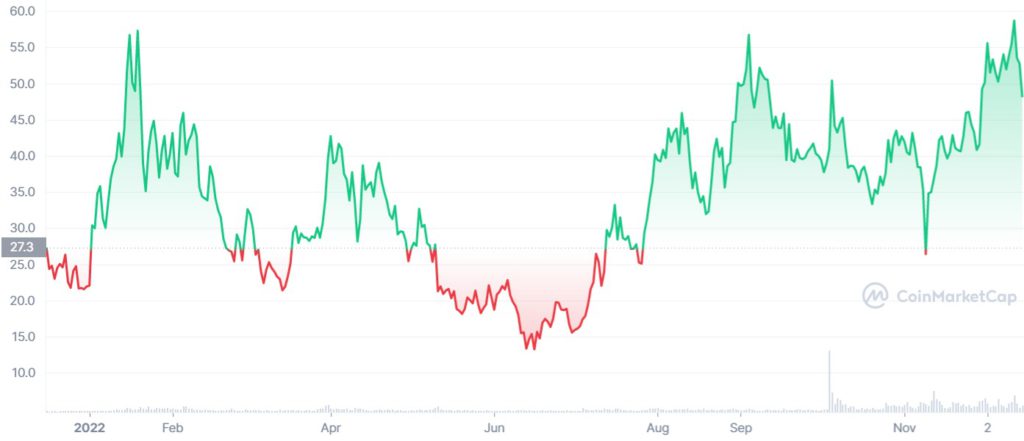
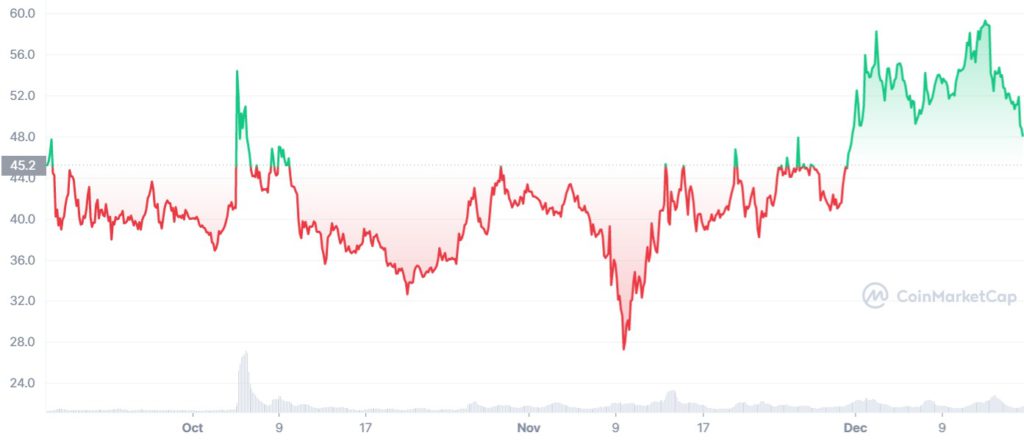
I’m not thrilled with the short-term outlook for GMX. It’s currently trading at around $51. That’s about $11 less than its 52-week high. I wouldn’t be surprised if it drops in the near term. So make sure you dollar cost average into your position (buy a small fixed amount each week until you purchase all of the GMX that you want). I am bullish on GMX’s mid- to long-term potential, however.
When the next bull market hits, I expect investors and speculators to flock to GMX’s perpetual contract market. It’s not my cup of tea. It involves too much leverage and too much risk. But I know others will likely use it in numbers. And that should drive GMX’s price well beyond $62.
The fact that GMX is performing so well in a bear market is a good indicator that this project has what it takes to succeed over the long run. And given the problems we’re seeing with centralized exchanges, this might just be the right solution at the right time.
We’re still in a crypto bear market. And that means any crypto investments made right now are more risky than usual. That said, I believe GMX provides an attractive risk-reward ratio. If you’re interested in investing, you can acquire GMX on KuCoin.
Rules of the Road
Investing in a bear market is tricky. It is likely that the market will go down further from here. But it’s important to be opportunistic. So if you have capital to invest — and you’re psychologically and emotionally willing to enter what promises to be a highly volatile market — here are some guidelines to follow.
- Do not invest money you can’t afford to lose. The markets are in for a rough ride. If you can’t afford to lose the money, don’t risk it.
- Focus on projects with strong use cases.
- Look for teams or communities that are active and committed to their projects.
- Always enter a position using dollar cost averaging. That means buying a small amount each week rather than buying your entire position at once. That way, if prices continue to fall, you lower your overall acquisition cost.
- Don’t try to time the market perfectly. Nobody can. And I believe this bear market will be around for several months. So if you want to wait, that’s perfectly okay. But when you do invest, make sure you utilize dollar cost averaging to buy into the market.
- Diversify your crypto portfolio. From a percentage standpoint, bitcoin and ethereum should be the biggest investments in your crypto portfolio. But you need exposure to a much broader and more diverse set of coins to take advantage of the full upside of the crypto markets. Bear markets are a good time to diversify your portfolio and increase exposure to different crypto sectors.
Remember, investing in crypto is risky. Investing in a crypto bear market carries even more risk. Less than 5% of your overall portfolio should be invested in crypto.