As you know, the crypto market has been hurting lately.
But we just received a good reason to be optimistic (and opportunistic).
On Thursday, The Wall Street Journal reported that a senior SEC official said Ethereum is NOT a security. Here’s the quote from SEC Director of Corporation Finance William Hinman:
| Based on my understanding of the present state of Ether, the Ethereum network and its decentralized structure, current offers and sales of Ether are not securities transactions. |
This tells us the SEC is taking a positive approach to crypto. As we’ve been saying, it doesn’t want to be seen as hampering innovation.
But the SEC official did note that some coins/tokens are still likely to be classified as securities. Apparently, it’s looking closely at the ICO/distribution structure and how well the project is decentralized. Here’s some analysis from CNBC:
|
Hinman said the primary issue in determining whether cryptocurrencies and ICOs were securities was the expectation of a return by a third party, specifically whether there was a person or group that sponsored the creation and sale of the asset and who played a significant role in its development and maintenance. For purchasers of the asset, the key is whether they are seeking a return on the investment.
If there is a centralized third party, along with purchasers with an expectation of a return, then it is likely a security, Hinman said. |
More from CNBC:
| Hinman specifically said that bitcoin is not a security because it is decentralized: there is no central party whose efforts are a key determining factor in the enterprise. |
Indeed, decentralization is key. And our coins are well-positioned for this development. Most are unlikely to be classified as securities. I’ve done a lot of analysis on how this could all go down, and I believe we’re in a good spot (despite recent price action).
Here’s one final quote from Hinman, and it indicates that we’ll have even more clarity soon:
| We stand prepared to provide more formal interpretive or no-action guidance about the proper characterization of a digital asset in a proposed use. |
Turning Point?
This could be a turning point for crypto markets. As I write this, markets have rebounded sharply on news that the SEC is taking a crypto-friendly approach. It has now stated that bitcoin and Ethereum are NOT securities. More guidance is coming.
To me, this means we remain on track for a major institutional boom in crypto. The clarity we’re getting on regulation helps immensely.
And the infrastructure to support this initial boom is being built or launched now.
For example, Coinbase just officially launched its “index fund” of cryptos for wealthy investors and institutions. The fund will initially consist of bitcoin, Ethereum, Bitcoin Cash and Litecoin. It will be weighted by market cap. The minimum investment is $250,000. There’s a hefty 2% management fee, but I expect that costs will drop as competition increases.
And of course, Coinbase wants to launch funds that anyone can invest in. And it won’t be the only one. It will be a crowded market, with fierce competition. This is a very good thing.
These new “official” products will bring bags of new money into the market. These funds and other developments currently in the works (ETFs, Nasdaq and the parent company of the New York Stock Exchange building storage and exchange solutions, etc.) should help boost prices for years to come.
I’m more bullish today than I’ve ever been. Try to take advantage of uncertainty and buy during major sell-offs. We’ll try to help you find the buying opportunities (in my opinion, now’s a pretty good one). It’s not possible to nail the bottoms all the time, but the important thing is to be well-positioned for the midterm to long term.
If you wish to play it cautiously, I continue to recommend dollar cost averaging into positions: Buy the same amount every week, or month, for an extended period.
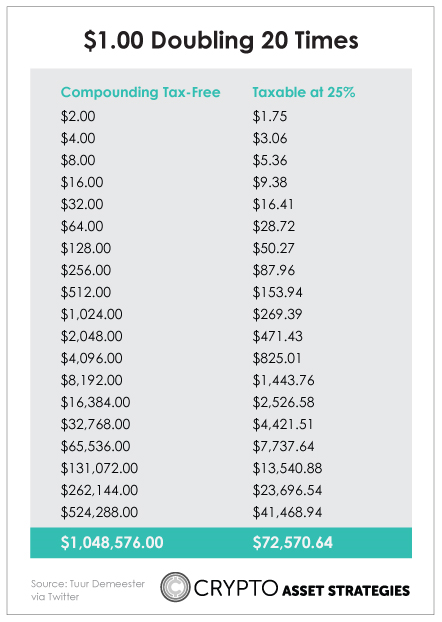
Besides that, just hold. As you can see from the chart below, it is far better to simply hold than trade frequently, even if you time it well. The frequency of capital gains taxes kills the natural compounding effect of holding.
Good investing,
Adam