Bitshares
Ticker: BTS
Exchanges: Binance or BitShares Asset Exchange
Price: $0.10
Market cap: $273 million
Circulating supply: 2,653,190,000 BTS
Max supply: 3,600,570,502 BTS
Dear Member,
BitShares is a leading blockchain-based financial platform. Think of it as a decentralized crypto bank, exchange and securities firm. It allows for the creation of crypto assets that are “pegged” to the price of real-world assets, and it has a decentralized exchange to trade them on.
BitShares is a blue chip cryptocurrency project. Dan Larimer created it in 2014. Larimer is also the creator of EOS and social network Steemit, two of the world’s most popular blockchain projects.
BitShares’ model is slightly complex, and we’ll get to it in a moment. But one of the most exciting things about this project is that it’s one of the world’s most actively traded tokens. BitShares has a real working product that’s being used to trade crypto assets.
In fact, bitshares currently ranks third on a leaderboard of blockchain transactions over the past 24 hours (and is significantly higher than bitcoin).
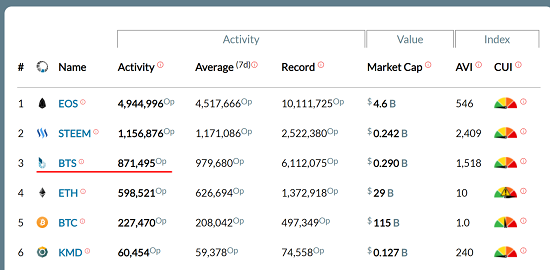
BitShares has learned a lot of lessons since its 2014 launch. And it’s made a lot of improvements, which have rendered it a battle-hardened veteran of the crypto world.
BitShares’ native cryptocurrency is bitshares, which is what you’ll be buying.
The Model
BitShares is a blockchain platform applications can be built on top of – similar to Ethereum but with important differences. BitShares uses a delegated-proof-of-stake consensus system in which users vote for delegates to process transactions and represent the user base.
The primary application running on this blockchain today is the BitShares Asset Exchange. It’s a decentralized exchange, and some $5 million in crypto assets trades hands on it every day.
Decentralized exchanges are an important and developing part of the crypto ecosystem. Centralized exchanges like Coinbase are vulnerable to being hacked (among other things). Even though Coinbase is very secure and we trust it, it’s the weakest link in the chain. Decentralized exchanges remove that single point of failure.
On the BitShares exchange, anyone can create their own “SmartCoins,” the prices of which are tied to underlying assets. (There are coins tied to major fiat currencies, precious metals, oil and more.)
It is an active financial marketplace, with lending, shorting, holding and more. Popular BitShares SmartCoins include ones pegged to the dollar (bitUSD), the Chinese yuan (bitCNY) and gold (bitGold). These SmartCoins closely track the prices of the pegged asset, so investors can use them to get exposure to foreign currencies and other assets. These are the most popular assets that trade on BitShares today, but the possibilities for others are endless.
By volume, the most popular asset trading on the BitShares exchange is bitshares itself, with around $3.5 million traded in the last 24 hours. A SmartCoin pegged to the Chinese yuan is the second most popular asset, with around $2.5 million traded in the last day.
Transactions that take place on the platform are priced in bitshares and require fees paid in bitshares. The other practical use of bitshares is as collateral on the platform. All the coins created on BitShares require collateral (in the form of bitshares) to operate.
BitShares has a well-thought-out margin system. If the value of the underlying asset no longer supports the SmartCoin’s price, the user’s collateral can be liquidated in a “margin call” if their bet goes the wrong way. The details are complex, but that’s often the reality in fintech cryptocurrency projects.
I think these SmartCoins (also called stablecoins) are going to be a big thing in cryptocurrency. They’re tokens that track the price of real-world assets. Sort of like crypto ETFs. (Read this article I wrote to learn more about the potential of stablecoins.)
BitShares has effective incentives built into the ecosystem for transaction processing, referring new users and trading on the platform.
BitShares is great at communication, which is immensely important in the crypto world. I’ve never seen BitShares miss a weekly update, and the updates are always packed full of adoption stats, network updates, etc. Here is the latest one. The easiest way to see all the updates is to follow BitShares on Twitter.
As I mentioned, the model is complex, and it may take you a while to fully understand it. I recommend reading the updates and watching some videos on YouTube.
Practical and Legal-Friendly
BitShares has been upfront about the fact that it may have to seize assets or reveal information about wallets if ordered to do so by a court. This angers many cryptocurrency purists. They believe it violates everything that cryptocurrency stands for.
But I believe that, on balance, it’s a savvy decision. Frankly, government has a scary amount of power. Refusing to cooperate on issues related to money-laundering or illicit sales would be crazy.
Anyone who’s doing money transactions online has to respect the law – and BitShares recognizes this. It follows know-your-customer rules. And the platform is built with a regulation-friendly approach in mind.
Ideally I would prefer a fully self-regulating platform. But that’s simply not realistic in today’s regulatory world. BitShares has a number of safeguards in place to prevent abuse of the system, and it’s in everyone’s best interest to keep things fair.
Self-Funding Mechanism
BitShares has a functioning, efficient self-funding mechanism in place. A portion of every bitshares transaction fee on the network goes into a treasury, which is then used to pay developers. It’s all publicly viewable.
Developers can submit proposals about the changes or additions they want to make and quote a price for the job in bitshares. Delegates then vote on the most promising proposals. It’s transparent, and it’s working.
Here’s an excerpt from BitShares.org about “Stakeholder-Approved Project Funding“:
| BitShares is designed to be self-funding and self-sustaining by giving the stakeholders the power to direct where blockchain reserves are spent. BitShares has a reserve pool of 1.2 billion BTS (about $8 million) that automatically grows as transaction fees are collected and the share price rises. Each day, the blockchain is authorized to spend up to 432,000 BTS (about $77,000 per month), which is enough to hire a small team to maintain the network for years, even with no price appreciation. |
Timing
BitShares very briefly touched $0.87 back in January. It trades at $0.10 today. We’re getting a nice discount here. The project is still growing, putting out regular updates and moving forward.
Technically, this token appears to be bottoming. That could change, of course. If you’re a cautious trader, averaging in to your position can be a smart move. Start with a small chunk, get comfortable with the token and the network, and then buy more if it makes sense to you.
Performance
BitShares uses a highly scalable programming framework called Graphene. BitShares claims its platform is capable of 100,000 transactions per second. That’s far more than Ethereum, which processes around 13 transactions per second.
Here’s an excerpt from BitShares.org:
|
Graphene is capable of 100,000 TPS when we pay for the network to go with it.
High performance blockchain technology is necessary for cryptocurrencies and smart contract platforms to provide a viable alternative to existing financial platforms. BitShares is designed from the ground up to process more transactions every second than Visa and Mastercard combined. With Delegated Proof of Stake, the BitShares network can confirm transactions in an average of just one second, limited only by the speed of light. |
BitShares is all about scalability. It’s not up to 100,000 transactions per second yet, but the system is built to withstand that level of volume. It aims to blow Ethereum and other platforms out of the water. Here’s another excerpt from BitShares.org with details on how it makes the platform so robust:
To achieve this industry-leading performance, BitShares has borrowed lessons learned from the LMAX Exchange, which is able to process 6 million transactions per second. Among these lessons are the following key points:
Future optimizations are expected to bring the performance of BitShares to levels similar to LMAX. |
How to Buy and Store
I recommend buying this coin on Binance or BitShares Asset Exchange. We have instructions for buying on Binance here. Just search for “BTS” and confirm that you’re buying bitshares.
And when transferring coins, make sure you only send bitcoin to a bitcoin wallet (some coins have trading pairs with ethereum).
If you buy on Binance, I recommend using a limit order, since volume is fairly low there. Volume is better on BitShares Asset Exchange, but the user interface takes some getting used to.
You can keep your bitshares on an exchange or download a local version of the wallet (not for beginners).
Risks
Like all cryptocurrencies, buying bitshares carries significant risk. Never invest money you can’t afford to lose. You should only invest a very small portion of your overall investments in cryptocurrency (1% to 5%).
There are technological risks, regulatory risks and the risk that the project runs out of money. These are all part of the risk we take when investing in crypto (due to the unparalleled upside).
Resources
Good investing,
Adam